
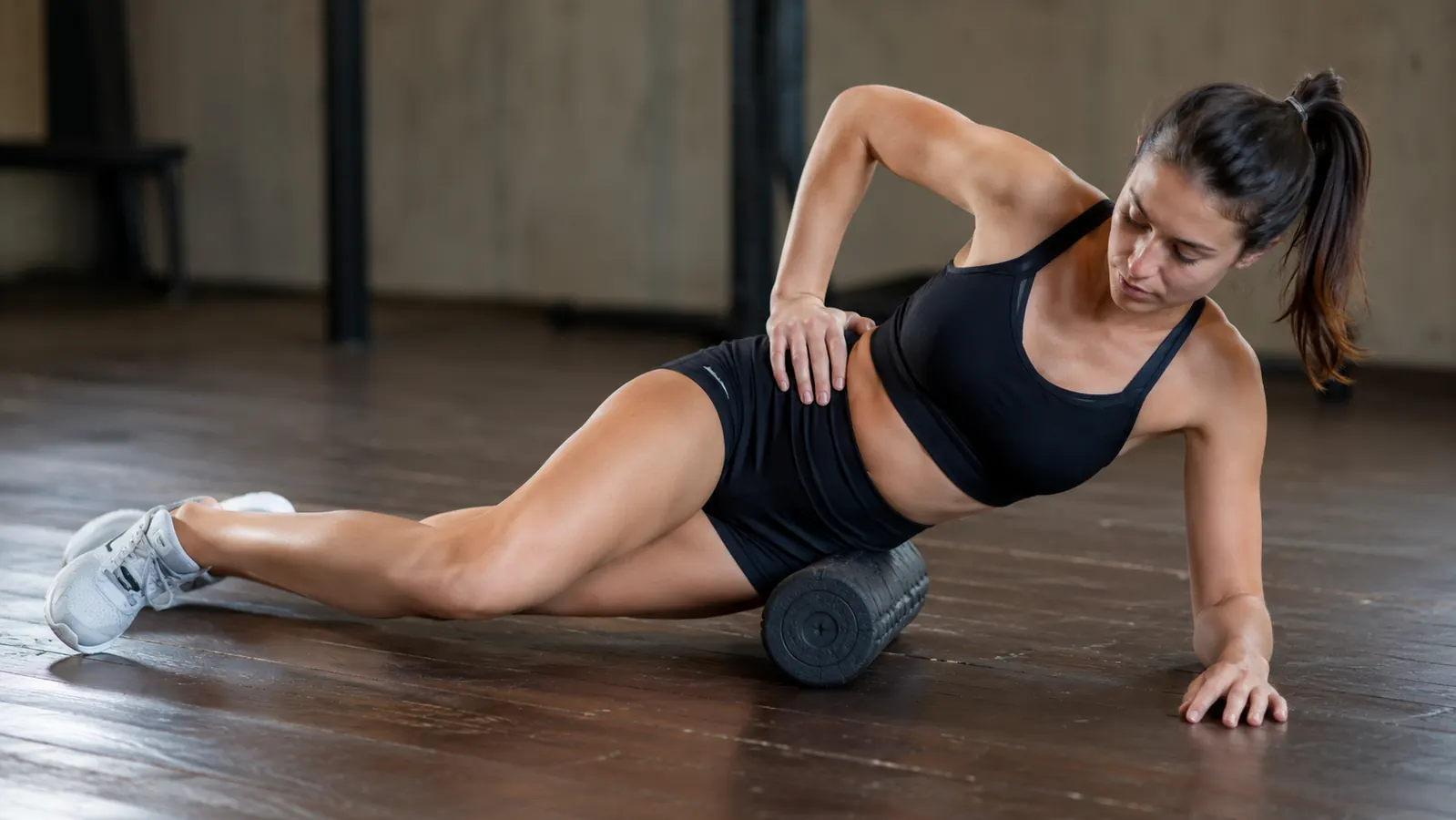
If your outer knee aches after runs or leg day, there is a good chance your IT band is the culprit. The iliotibial band runs from your hip down the outside of your thigh to just below the knee, and when it gets tight, it pulls on everything in its path. Most people respond by foam rolling directly on it as hard as they can, grimacing through the pain, then wondering why nothing improves. This guide covers how to foam roll the IT band correctly, including the positions that work, the pressure that actually helps, and the steps most people skip that make the difference.
One thing worth knowing upfront: the IT band is a thick fibrous band of connective tissue, not a muscle. You cannot stretch it out the way you stretch a hamstring, and you cannot compress it into submission by rolling over it repeatedly at full bodyweight. What you can do is work the surrounding tissue, shift fluid, and reduce tension in the structures that feed into it. That is what this protocol targets.
If your roller is beating you up instead of helping, a softer compression option changes the protocol entirely
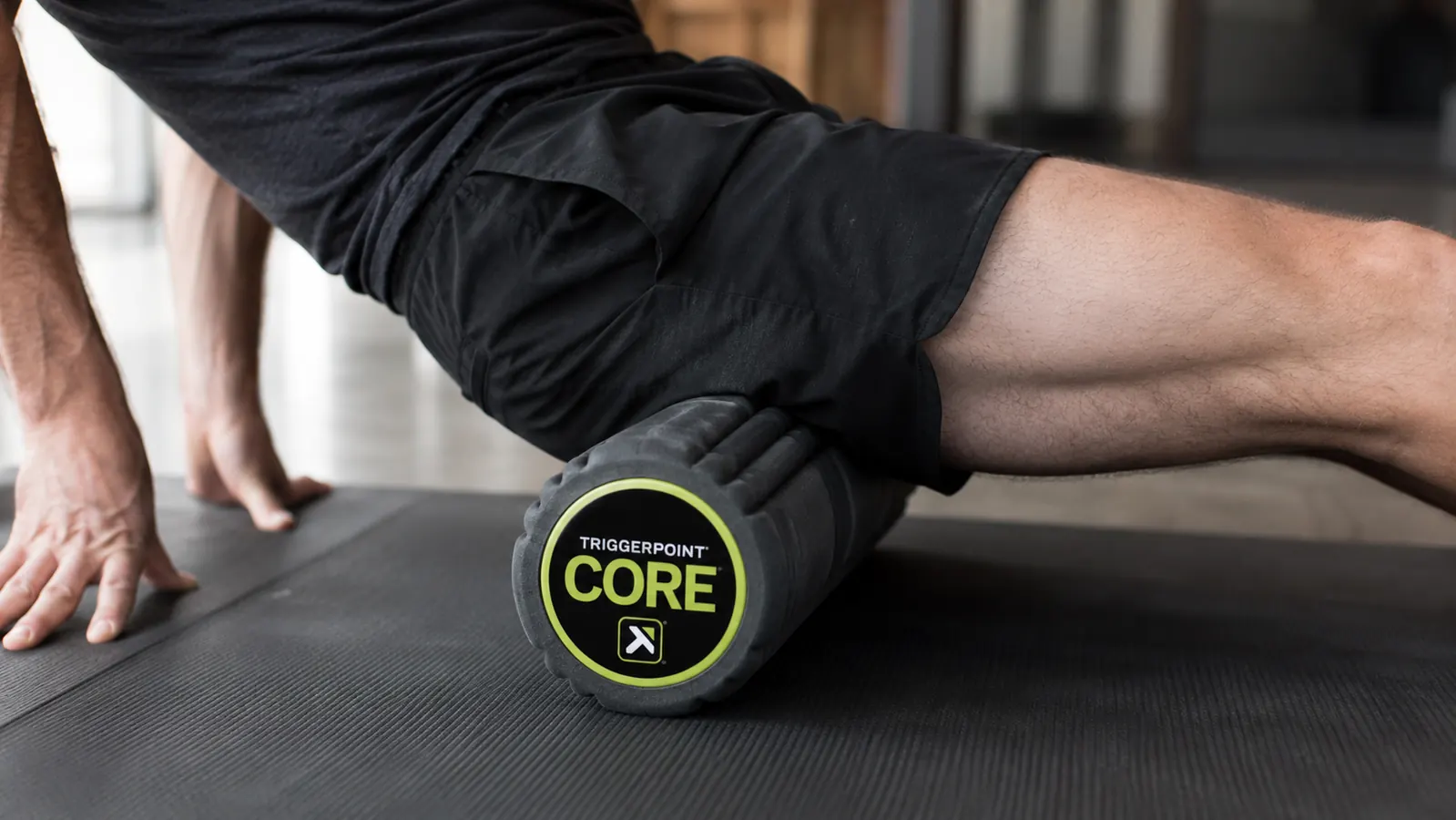
The TriggerPoint CORE Foam Roller uses a softer EVA foam layer over a rigid core. That combination gives you firm support without the bruising feel of a hard-shell roller, which is exactly what you want when working a sensitive area like the IT band.
Amazon Check Today's Price on Amazon →Step 1: Loosen the TFL Before You Touch the IT Band
The tensor fascia latae (TFL) is the small muscle at the top of your outer hip that connects directly into the IT band. When the TFL is locked up, it keeps the entire band under constant tension. Rolling the IT band while ignoring the TFL is like trying to untangle a rope while someone is still pulling on one end.
To hit the TFL, roll to your side and position the roller just below your hip bone on the outer hip, not on the side of the thigh yet. Apply moderate bodyweight, around 50 to 60 percent, by keeping your support arm under you. Make slow 2-inch passes back and forth for 60 to 90 seconds. If you find a tender spot, pause on it for 20 seconds before moving on. Do both sides even if only one knee is giving you trouble, because hip imbalances usually run bilateral.
A softer roller like the TriggerPoint CORE handles this area better than a hard PVC roller. The TFL sits close to the hip socket and pelvic crest, and a roller with no give tends to press into bone rather than tissue. The CORE's layered construction lets it conform slightly to the area, which means you get actual tissue contact instead of just skipping over the bony edges.
Step 2: Work the Outer Quad, Not the Band Itself
The vastus lateralis is the outermost head of the quadriceps and runs right alongside the IT band. When it gets tight, it creates a mechanical tug that loads the band further. Releasing it is often more effective than rolling the band directly, and it is far less painful.
Shift the roller from the TFL down to the upper outer thigh, staying on the fleshy muscle tissue rather than the band itself. You are targeting roughly the area from the mid-thigh upward. Keep your body at about a 15-degree angle toward the floor (not fully on your side, slightly face-down). Use your forearm and opposite foot to control pressure. Slow passes, no bouncing. Spend 90 seconds here per side. If the outer quad is extremely tender, that is a sign it is contributing significantly to your IT band tension, and this step deserves extra time before you move on.
Step 3: Roll the Glutes and Piriformis
Tight glutes, especially the piriformis, can refer tension all the way down the lateral line into the IT band. This is the step most people skip because it does not feel like IT band work, but it is often the step that creates the most relief.
Sit on the roller with one ankle crossed over the opposite knee (a figure-4 position). Lean slightly to the crossed-ankle side so the roller is under the outer glute and piriformis. Slowly tilt forward and backward in small movements. When you find a sore spot, hold it for 20 to 30 seconds. Switch sides and repeat. This takes 2 to 3 minutes but regularly produces the kind of hip release that makes the entire IT band area feel less wound up. For reference on why this matters, the benefits of consistent foam rolling compound when you address the entire lateral kinetic chain rather than one isolated spot.
The IT band itself rarely needs to be rolled hard. What it needs is for everything feeding into it to stop pulling so tight.
Step 4: Do the IT Band Pass at Partial Bodyweight
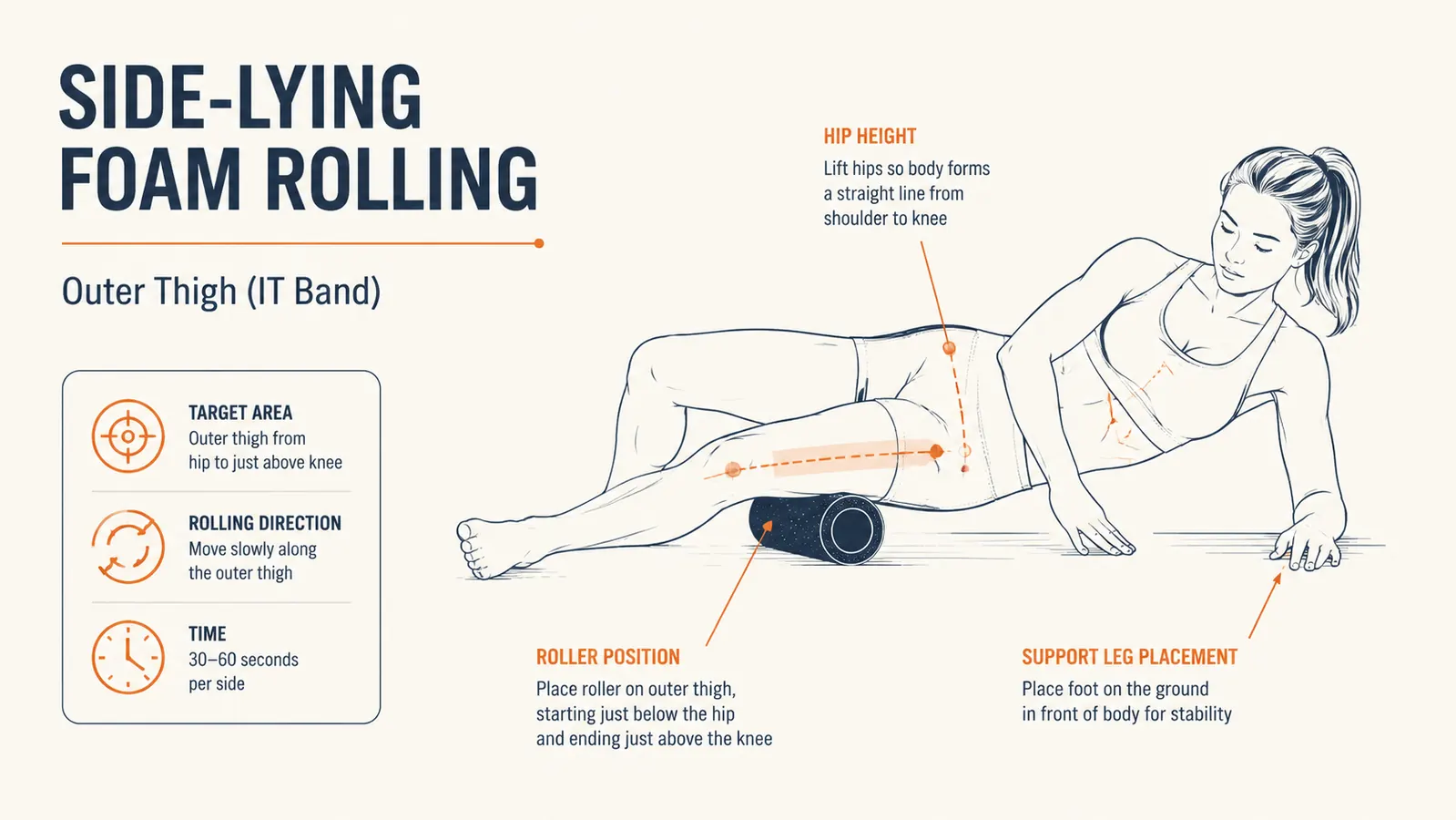
Now that the surrounding tissue is warmer and less wound up, you can do a direct pass along the IT band. The key word is partial. Do not drop your full bodyweight onto the roller along the outer thigh. That compresses blood vessels, creates bruising, and triggers a pain-guarding response that tightens the very tissue you are trying to relax.
Lie on your side with the roller under your outer thigh, just below the hip. Place both hands flat on the floor for support and keep significant weight on your arms and your top leg's foot, which should be planted on the floor in front of you. Start with maybe 30 to 40 percent of your bodyweight on the roller. Slowly roll from the hip down to just above the knee, stopping before the joint. Pause at any tender spots for 10 to 15 seconds without moving. Three slow passes in each direction is enough. Going longer does not help and often causes the area to flare up the next day.
The TriggerPoint CORE matters most in this step. Its softer outer foam layer means you can actually load the area slightly without the kind of acute pain that a hard-shell roller produces at 30 percent bodyweight. That manageable pressure is what allows the nervous system to relax instead of brace, which is the whole point.
Step 5: Finish With Hip Flexor and Calf Work
The IT band attaches at the lateral knee, and tension from below, specifically a tight calf and peroneals, can load that attachment point from the other direction. Spending 60 seconds on the outer calf (peroneal muscles along the outside of the lower leg) with the roller can reduce the tug at the knee end of the band.
Similarly, a tight hip flexor (psoas and rectus femoris) changes how your pelvis sits, which alters the angle at which the IT band is loaded during movement. After the calf work, finish with a 60-second kneeling hip flexor stretch on each side, driving your hips forward into extension. This is the part of the protocol that closes the loop on the whole lateral kinetic chain, from hip to knee to lower leg. If you want a more complete picture of what consistent rolling can do over time, the full TriggerPoint CORE review covers three months of regular use across multiple muscle groups and what actually changed.
What Else Helps When the IT Band Is Flaring
Foam rolling addresses tissue tension, but IT band syndrome is usually a load management problem at its root. Too much mileage, too fast an increase in training volume, or running a cambered road consistently on the same side are the most common culprits. Rolling helps manage symptoms, but if the underlying load issue is not addressed, the tightness keeps coming back.
Two exercises that address the mechanical cause rather than just the symptom are lateral band walks and single-leg glute bridges. Both strengthen the hip abductors, particularly gluteus medius, which is the primary stabilizer that keeps the knee from tracking inward during running and squatting. When the glute med is weak, the femur internally rotates with each step, and that rotational stress is transferred directly into the IT band. Three sets of 15 lateral band walks and single-leg bridges, three times per week, is enough to make a measurable difference in most people within four to six weeks.
If you are dealing with acute pain at the lateral knee, not just tightness, back off direct rolling over the band entirely for a few days. Roll the surrounding tissue only (glutes, outer quad, TFL, calf), do the strengthening work, and use ice for 15 minutes after activity to manage inflammation. Return to the direct IT band pass only when the acute pain has settled down.

Frequency matters too. Rolling the IT band area daily during a flare-up is more effective than occasional long sessions. Five minutes done consistently every day produces better results than 20 minutes once a week. The tissue responds to repeated, moderate input over time, not to single extreme sessions.
A roller that works with your pain tolerance instead of against it makes you more likely to actually do this every day
The TriggerPoint CORE Foam Roller's softer compression is the reason I stuck with the IT band protocol long enough for it to actually work. Hard rollers made me dread the session. The CORE made it something I could get through without gritting my teeth, which meant I did it consistently.
Amazon Check Today's Price on Amazon →